Most writers make content. I write commitment documents.
The article that mapped the way into a brand-new market, the plan document that was the product, the strategy a hundred and fifty frontline employees could see themselves in.

Hi, I'm Delle. I write in the places where being misunderstood is expensive: biotech products, health plan documents, company turnarounds, all in highly regulated industries where customer safety is on the line. I'm most useful in the room where the confusion is, not just at the keyboard afterwards.
THE WORK
ARTICLE
SALES TRAINING
INTERNAL BOOKLET
HEALTH PLAN DOCUMENT
Trade Journal Article: Creating a market
THE ROOM
Me
A member of the product team to answer product capability questions
The Director of Food and Feed, as the technical reviewer
The Director of Marketing, who had final sign-off
THE HARD THING
Position Bioo Scientific as the authority on the Raised Without Antibiotics market, which was then a new consumer trend and therefore a new challenge for food producers (our customers) to meet.
WHAT I DID
Researched consumer sentiment on “Raised Without Antibiotics” labeling
Researched what was being marketed as "Raised Without Antibiotics" and the challenges faced by new market entrants
Researched similar and adjacent labels and their standards
Wrote an agricultural trade journal article educating food producers on the advantages of entering the Raised Without Antibiotics market, how to do so, and the role of antibiotic test strips as aids to consumer trust and supply chain integrity, as soft category marketing for Bioo Scientific's antibiotic test strips
WHAT CHANGED
Positioned Bioo Scientific as a market authority in front of exactly the people who would buy from it: the industry journal's estimated audience of 36,882 (circulation plus share).
This article served as both an inbound marketing source and a credibility builder for our sales reps at trade shows, conferences, and sales meetings.
WHAT YOU CAN SEE
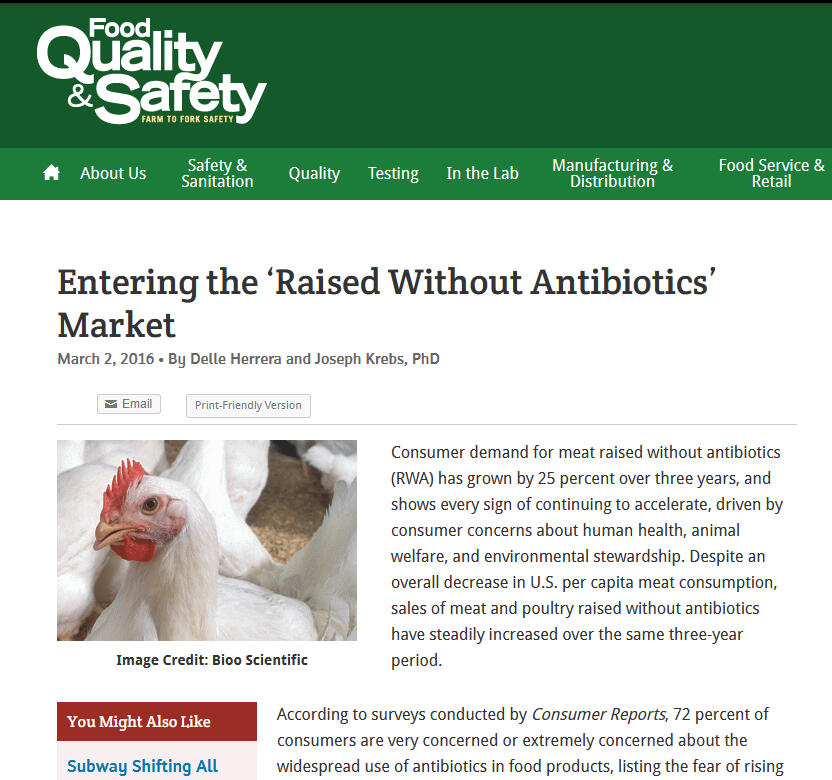
The article appeared in Food Quality and Safety Magazine, and you can see it on The Wayback Machine here.
Sales Enablement: Training the sales team when everything changed
THE ROOM
Me
The brand-new second-in-command of HR
The entire sales team
THE HARD THING
This health payer was decades old and the sales reps had many years of experience selling the old product.
As part of a company turnaround, we completely redesigned the product, rendering all of the team’s hard-won knowledge obsolete at the same time a big sales push was called for to save a hemorrhaging company.
The sales team had to be trained on the new product fast.
WHAT I DID
Drew on my background in the underlying model to get up to speed fast on the product redesign (participating directly in the plan document design process helped; see Health Payer Plan Document: The document that is the product)
Became an interdepartmental SME on the product
Led several weeks of interactive in-person training sessions on the product for the sales team
Provided presentation feedback as sales reps presented on the new product
WHAT CHANGED
This previously hemorrhaging company experienced 14% membership growth. (Typical for a health payer, but most health payers don’t start from negative.)
And I got a lot of lovely, detailed, thank you emails from members of the sales team.
WHAT YOU CAN SEE
Sales enablement is almost always confidential. You'll have to take the sales team's thank you emails on faith.
Turnaround Enablement: Explaining why we’re doing what we’re doing
THE ROOM
Me
The Art Director
The director of each department of the company
The Executive Director
The Deputy Executive Director
THE HARD THING
The executives had worked out this turnaround strategy at a long weekend retreat where they debated, challenged their thinking, changed their minds or settled their hypotheses, and by the end they had the overall strategy and the minute frontline directives down in their bones.
However, the frontline employees weren’t there, didn’t get it, and from where they were sitting saw only the thousand disconnected tasks that required overhauling their whole workflow for no obvious gain.
People were frustrated and demoralized, and didn’t know why they had to do unpleasant things without results they could see.
The hard thing was uncovering and then communicating the hidden knowledge in executives’ heads to every employee of a 150-person company so they could see how their everyday tasks and the slog of the process overhaul mattered.
WHAT I DID
Interviewed the Executive Director, Deputy Director, and heads of each department about:
the company’s Wildly Important Goals (4DX framework)
the high-level view of each department’s contributions to the Wildly Important Goals
and how the tactics at the high level broke down to the process
Worked with the Art Director to produce an easy-to-flip-through booklet and a cubicle-hanging mini-poster showing:
the Wildly Important Goals (WIGs) the WIG-focused projects and subprojects going on in each department
the intended timeline for each
WHAT CHANGED
Suddenly everyone could see how what they were doing helped their department, their friends in other departments, and the company as a whole.
This was extraordinary for the spirit of the turnaround, and a lot of people dropped by my desk or stopped me in the hall to tell me they appreciated this piece of work.
Many employees had worked at this company for decades and were very loyal. People had been unhappy not because the company was asking them to do unpleasant things, but because they didn’t have a good view of why.
WHAT YOU CAN SEE
These are internal strategy documents, so all I can show is the cover as a teaser.
Health Payer Plan Document: The document that is the product
THE ROOM
Me, as permanent delegate of my boss the Director of Communications
The Executive Director
The Deputy Executive Director
The Chief Counsel and two of her attorneys
The Director of Underwriting
A very intrepid Executive Assistant who somehow managed to keep everyone’s changes straight
THE HARD THING
For a health payer, the plan document isn't about the product — it is the product.
Every word is a commitment the company will be held to for the next plan year.
It is the document that patients will use to look up what’s covered, the document that will be referred to in appeals, arbitration, and court cases.
WHAT I DID
Debated, discussed, and refined policy content and language in the plan document, in working sessions with the Executive Director, Deputy Executive Director, Legal, and Underwriting, participating in product-defining decisions
Drew on my background in the cost containment model to which the company was transitioning, to contribute policy suggestions and patient advocacy in real time
Researched patient advocacy organizations' recommendations on a condition of particular interest to the membership base and executive leadership, and presented the report to the Executive Director for her consideration in coverage deliberations with Underwriting
WHAT CHANGED
Two months in the room produced the product itself: a plan document argued into consensus, cleared with Legal, and shipped with plenty of time before the start of the plan year, every coverage provision decided for the new model and the turnaround, not carried forward from “the way we’ve always done it.”
And the knowledge compounded: two months of helping build the product made me one of the top subject matter experts in the company, enabling me to train the sales team on the product with the deep knowledge you can only get from stress-testing the product. (See Sales Enablement: Training the sales team when everything changed).
WHAT YOU CAN SEE
Another cover teaser; health plan documents are not confidential per se, in that all members have them, but posting them where competitors may see them is, at the very least, terrible manners.